Posts filed under ‘trees’
Bloom Compare: Mount Rogers
Here are three pictures taken at Rhododendron Gap at Mount Rogers. The first was by me on June 7, 2008. The second one was by Nick from the Roanoke Outdoor and Social Club on June 14, 2008. The last one was taken by PassionPhish on June 16, 2008.

June 7, 2008 – All green

June 14, 2008 – And now there is pink (Photo by Nick)

June 16, 2008 – Still pink (Photo by PassionPhish)
How Fast Can I Post About Mount Rogers?!?
Okay. Been busy. Been real busy. And I promise to be busy for the rest of this month. But, I do need to revel in how awesome Mount Rogers was. So let’s see how fast I can get through this.
Time: 9:25 PM.
Our Crew
This year, we had 5 people in our crew. Tony Airaghi and Paul Ely went up Friday night. Meanwhile, Bill C, PassionPhish and I (oh yeah and Jimmie) hiked up on Saturday.

Our crew – Bill, PassionPhish, Jimmie and Me. (Photo by PassionPhish)
Saturday afternoon, we joined up with Paul and Tony at the campsite.

Paul blows on the fire while PassionPhish and Bill watch
Food
It seems I pick up a food souvenir from every hiking partner. When I pack an avocado, I think of Tony Airaghi. When I pack an orange, I think of Mike E. And now, whenever I pack a big block of extra sharp cheddar cheese, I’ll think of PassionPhish. That was by far the most addictive dish (and we had smores ingredients with us!!!!). I could not get enough of that cheese. And when it got warm… it looked nasty, but it was even MORE delicious.
Blooms
We were a little early in the bloom cycle for the rhododendrons. But that was good news because it meant the Roanoke Outdoor and Social Club, who was hiking the following weekend, got to see the peak blooms!
As we hiked to camp via the Pine Mountain Trail, I said to my companions, “Well… maybe by tomorrow they’ll open up a little more.” I was just being optimistic. I didn’t really believe there would be much of a difference between Saturday and Sunday, but there was! We hiked the same trail back and lo and behold there was a stunning difference.

Second Day Blooms

Ponies
Baby ponies were as cute as usual.

Coyotes
Okay. Well, I just recently watched a recent Jessica Piscitelli story on YouTube where she describes the fear she felt one camping trip when she heard a “bear”.
I had a moment of my own at Mount Rogers. In the middle of the night I woke up and could hear a bunch of coyotes yelping around to each other. They seemed awfully loud, so in my mind they were pretty close. I never reached the point where my fear had me call out to my companions. But I definitely laid awake a while, wide-eyed, monitoring the situation. And actually, I was not afraid for me. I was worried this vicious pack of coyotes would decide that Jimmie was particularly appetizing. And what was my beloved dog doing during this imminent attack? He was curled up at my feet, sound asleep, oblivious of any danger. And perhaps the dog knew best because I never heard any more from the coyotes.
Bees
When we were on Wilburn Ridge, we walked single file southbound on the Appalachian Trail. Suddenly a giant buzzing cloud passed to our right. It was so substantial and so loud, it didn’t seem real.
“Was that–?” Thomas uttered.
I pointed and said, “Bees?”
The cloud continued its way south. Suddenly the swarm took an abrupt left turn, right in to a couple of northbound hikers who promptly started doing a skin-crawling jig and swatting session. Alas, the couple did get stung. In retrospect, I wish that I had yelled out something, but I was so dumbfounded at the bees, I really did not digest the danger.

The two northbound hikers, after their bee attack
Emetophobe No More
Saturday evening, Paul and I were chatting with the father of the next camp over. The father is a mountaineer. Last year he climbed McKinley and this year he will be climbing Siula Grande. His stories were just fascinating, but as he talked I did notice something peculiar behind him. One of his young sons fell ill by the campfire. At first, I thought the kid was just spitting. The second wretch, it became clear it was not saliva exiting his lips. And by the third bout I interrupted the father and pointed.
“Uh…. your boy is sick.”
That boy went to bed shortly after that and the next day he was up and at ’em, climbing rocks and looking cute. So all ended well.
Which would not have been the case 7 years ago. That incident would have easily sent me in a tailspin. I would have spent the rest of the weekend worrying and thinking about all the germs on my hands. I may have cried and wanted to go home immediately. Whereas now, I can sit around the same fire, listen to stories and cook smores. So all ended well.

See all better already! Nothing to worry about!
Sunset and Smores
The seven-year old daughter of our mountaineer neighbor was not afflicted by her brother’s illness, so Tony, Paul and I spent a lot of time with her. We were the first people to expose her AND her mountaineer father to smores. I’m not sure if the father cared for the concoction or not, but the daughter asked for seconds! I think we may have also taught her another lesson. At dusk, Tony, Paul and I were heading to a rock on the Lewis Fork Trail to watch the sunset.
“Why would you want to watch a sunset?” the little girl asked.
So with permission from her parents, we took her with us.

Tony, Nikola and Paul wait for the sunset.
The colors and views were absolutely gorgeous. I can’t be certain, but I think she may understand the appeal now. 🙂
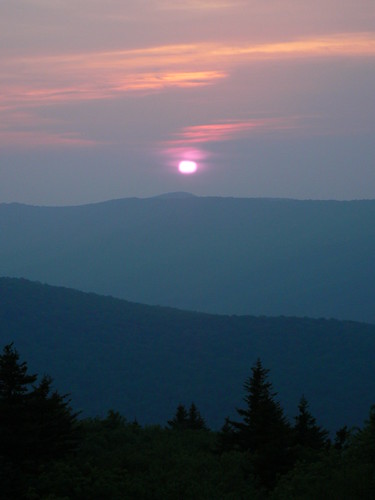
Sunset at 8:42 PM EST

Sunset at 8:55 PM EST
This was the third June in a row where I’ve made a trip down to Mount Rogers. I don’t intend for the streak to break. It’s a great trip and I will look forward to next year!
More pictures of our Mount Rogers trip can be found on my Flickr set as well as PassionPhish’s Flickr set.
Time: 11:27 PM
The Groomsman Reunion Tour
(Hat Tip to Matt. I blatantly stole the post name from him)
Saturday was a busy day. I drove up from Blacksburg to the DC area with three dogs, made a quick trip to Safeway and then my Mom and I frantically worked on some Chocolate Chip Cookie Dough Truffles. The truffles were rushed and not quite as pretty looking as usual, but they still retained that oh so delicious taste. Which was good, because they were my dish for a BBQ at Stacy and Louise’s house!!!
The BBQ was a mini-wedding party reunion from Stacy and Louise’s wedding last November. On the bride’s side “my” bridesmaid, Jenn, was present. The groom’s side was all accounted for! Best man Kipp was there as well as Groomsman Matt and of course, Groomsman Vicky (that’s me)!
My favorite part of the day would have to be around dusk when our whole group went for a walk through a park and an adjacent neighborhood. We even ran into a doe with a tiny, tiny, spotted fawn. I didn’t manage to keep my camera still enough for a decent shot.
Down here in Blacksburg, I have been looking up so many trees lately that as I stroll through the forest I see a lot of familiar leaves. Up in Chantilly, Virginia, the only trees I could recognize right away were sycamores. It just goes to show the diversity found in Virginia… and it aptly demonstrates that I have a lot left to learn about trees. 🙂
Anyway, some pictures. Most of these are courtesy of Matt. Note that my post-Locks of Love hair is finally long enough for a pony tail again! SWEET! I celebrated by wearing a pony tail every day this holiday weekend.

Me and the other groomsman, Matt. (Photo by Matt)

Stacy and Louise (Photo by Matt)

Bridesmaid, Jenn (Photo by Matt)

Casey and Louise Laugh

@$(&ing low light at dusk!
I definitely enjoyed our reunion and found it to be a very good way to kick off Memorial Day weekend. Perhaps Stacy and Louise could be convinced to make it a tradition.
As for more pictures, Matt has a set of party pictures on his Flickr site. I have a small set up as well. Finally, I’m sure eventually Casey will have hers up too.
Measuring Trees, Vicky-Style
Another personality followed in Richard Preston‘s book, The Wild Trees, was Michael Taylor. Michael Taylor was not a scientist or a climber. He was just a normal man (one afraid of heights at that) who one day decided that the tallest trees in the world were yet to be discovered. So he went out into the woods and looked for them. When he first started his explorations of northern California, his measurement technique was crude, but cost effective.
Taylor made his clinometer out of a plastic protractor […], along with a piece of string, a thumbtack, and a wooden pencil. The device cost him forty-five cents.
Later he started using a 19th century surveyor’s transit and then even later he used a laser range finder. But according to The Wild Trees, “there is only one way to determine the exact height of a tall redwood, and that is to climb up into it and run a measuring tape down it.”
That’s exactly what researchers did in September 2006 when they measured Hyperion at 379.1 feet and confirmed it was the world’s tallest tree.
For the layman, like myself, there are a lot of a different ways to measure the height of trees, some using angles, some using sticks and some simply measuring shadows. Over the years, I’ve half-assed my own technique which makes Michael Taylor’s hand-made clinometer look cutting edge.
- Make Jimmie stand or sit next to the tree.
- Take a picture
- Upload picture to Flickr for safe keeping
Now, if I am ever inclined, I can open the picture up and count the number of Jimmies to the top.

Jimmie “measuring” an American Chestnut tree (the tall skinny one next to his butt)

The tree is at least 8.5 Jimmies tall. Since Jimmie sits at 29″, the tree is roughly 20 1/2 feet tall.
Jimmie’s expertises are by no means limited to trees. His services are just as applicable to rocks or tree tumors.

Dragon’s Tooth is a little more than 10 sitting Jimmies high.

Jimmie, with apprentice Henry, “measuring” a tree tumor.
Of course, one day Jimmie will have to retire from hiking. So I suppose I should practice some of those other techniques.
You know, as backup.
Though added accuracy wouldn’t hurt. 🙂
Henry David Thoreau on the American Chestnut
The Blog of Henry David Thoreau features a daily excerpt from The Journal of Henry David Thoreau. I’ve found the blog and its excerpts to be fascinating. Thoreau’s entry on October 23, 1855 in particular stuck out to me. He spoke of sympathy for an American Chestnut tree:
Now is the time for chestnuts. A stone cast against the trees shakes them down in showers upon one’s head and shoulders. But I cannot excuse myself for using the stone. It is not innocent, it is not just, so to maltreat the tree that feeds us. I am not disturbed by considering that if I thus shorten its life I shall not enjoy its fruit so long, but am prompted to a more innocent course by motives purely of humanity. I sympathize with the tree, yet I heaved a big stone against the trunks like a robber,—not too good to commit murder. I trust that I shall never do it again. These gifts should be accepted, not merely with gentleness, but with a certain humble gratitude. The tree whose fruit we would obtain should not be too rudely shaken even. It is not a time of distress, when a little haste and violence even might be pardoned. It is worse than boorish, it is criminal, to inflict an unnecessary injury on the tree that feeds or shadows us. Old trees are our parents, and our parents’ parents, perchance. If you would learn the secrets of Nature, you must practice more humanity than others. The thought that I was robbing myself by injuring the tree did not occur to me, but I was affected as if I had cast a rock at a sentient being,—with a duller sense than my own, it is true, but yet a distant relation. Behold a man cutting down a tree to come at the fruit! What is the moral of such an act?
I wonder how much more extensive his regret would have been, had he known what laid ahead for the American Chestnut?
Prickley Pear Trail: First Blooms
Today I went for a quick hike with the dogs on the Prickley Pear Trail in the Poverty Creek Trail System. The rhododendrons at Mount Rogers aren’t expect to peak for another 2-3 weeks. But down a couple thousand feet at Poverty Creek, I found them blooming away. As an added bonus, the mountain laurel (real mountain laurel, not mountain pieris) was starting to flower as well.

Gorgeous rhododendron blooms over a beautifully textured bark

I love the shape of the wild rhododendrons and how they spread out and the branches twist and turn.

The first Mountain Laurel blooms opening up
More pictures of my trip on the Prickley Pear Trail can be found on my Flickr site.
| Prickley Pear Trail (From FS-708 to Skullcap Trail) Mileage: 3 miles round trip Elevation Difference: [Unsure, but I can say it doesn’t feel very steep] 4WD Requirements: Forest Service Road 708 is gravel and climbs a hill, but for the most part is well maintained. Trailhead Parking: There is a nearby pull off on the left in front of the Royale Trailhead Driving Directions: Take 460 West |
Trail Days 2008 – Meadowview Farms
How could Trail Days possibly top the outrageous fashion, the wet crossfire of the Hiker Parade, the inspiration of Gitty Up Clogger Evan Ritchie, the excitement of the new Virginia Appalachian Trail License Plate, and the hilarious entertainment of the Hiker Talent Show?!?
It’s easy! Offer a tour of Meadowview Farms, where the American Chestnut Foundation is working towards a blight resistant American Chestnut.

A barn at Wagner Farm
Once known as the redwoods of the east, today’s American Chestnuts don’t get a chance to reach the formidable size they were known for. As they grow, they get infected with a blight that immigrated from Asia in the early 1900s.
A species that evolved in closer contact with the blight, the Chinese Chestnut, had developed a resistance to the fungus. It reminds me of the ending of War of the Worlds. “By a toll of a billion deaths, [the Chinese Chestnut] had earned its immunity…” But the Chinese Chestnut is a different tree and doesn’t grow nearly as tall as the American. The Chinese Chestnut may thrive in our gardens and yards, but because it grows so short it struggles in the forests. It can’t compete with the taller trees like my sister‘s favorite, the Tulip Poplar.
There are a variety of approaches in progress to try to restore the American Chestnut to its former glory. Some organizations like the State University of New York College of Environmental Science and Forestry work to identify the genes responsible for blight resistance. Other research focuses on the hypovirus which attacks the blight fungus. At Meadowview Farms, their prime focus is a backcross breeding program.

View from the Wagner farm with a new planting area.
They started with a generation of trees that were half Chinese and half American. Then they backcrossed those trees with fully American parents. That next generation was backcrossed with another pure American parent and so on. Through breeding, the researchers are slowly developing the trees that are blight resistant and increasingly American. At the farms, I saw trees that are currently 15/16 American.

Generation BC3F2 – which is 15/16 American. These trees are all the same age. The smaller trees are ones that take more after their Chinese ancestor.
For us humans, the online dating sites all have their own means for identifying successful matches. The backcross breeding program at Meadowview Farms may be more stringent than the reportedly fickle eHarmony.com. With each new generation, the trees are carefully evaluated. First, the researchers want to see trees with more American traits. A tree that exhibits the shorter stature or other Chinese characteristics is eliminated. Next, and more importantly, each tree is purposefully inoculated with the blight. Cankers are measured and only the trees that exhibit blight resistance will be bred. Meanwhile, to preserve a large level of genetic diversity, pollen is collected from all over the country to serve as the pure American parents.
And this whole breeding process isn’t as simple as putting two trees together and adding Cabernet Sauvignon to the mix. The flowers of the trees have to be bagged at just the right time. Then the flowers are manually pollinated with the proper parent. When you are talking about tens of thousands of trees, this time-sensitive task is nothing to scoff at.

An American Chestnut at Wagner Farm
After the tour of the farms was complete, I loitered around the American Chestnut Foundation booth at Trail Days. While I waited for my carpool buddy, I eavesdropped.

Discussion at the American Chestnut Foundation Booth
It seems oral history is strong when it comes to the American Chestnut. Every person who came into a booth had an anecdote or memory to share about the tree. How they used to eat the chestnuts, spotted some saplings recently, or heard the barrage of white flowers used to make our Appalachian Mountains look snow-capped in the summer.
I’ve seen the same phenomenon in my personal life. My Great Uncle recollects posing for a picture by a huge trunk as a boy. My father tells me about trees he thought were large survivors. Just last week, I ran into an Appalachian Trail thru-hiker near Rocky Gap. His trailname was “Freebird” and when the subject of American Chestnuts came up, he too had something to say:
“My grandfather told me that it used to be a squirrel could travel from Georgia to Maine, just on the branches of American Chestnut trees.”
Back at the American Chestnut Foundation booth, one of the volunteers opened up a brochure and showed a visitor an old black and white picture of a huge American Chestnut.
“I’ll never see one this big. You’ll never see one this big.” She said, “But maybe our grandchildren will.”
And that was my favorite moment of Trail Days.
Rocky Gap
I am very lucky to live in an area with numerous A.T. trailheads. One of the most convenient to me is the VA-601 crossing. At that trailhead, a vast majority of recreational hikers will travel northbound to take in the views at Kelly’s Knob. But, I also recommend traveling southbound. Going down to VA-632 and back is a 4 mile round trip that you can fit in after work or even a weekend day before other obligations. On the down side, this does mean you can hike and still have ample time to do household chores.
This section may not have the overlook that Kelly’s Knob has, but it is beautiful in its own right. The rocky trail is lined with moss and ferns and when the time is right– blooming mayapples and azaleas. As far as exercise goes, your legs get more of a climb than they would to Kelly’s Knob. VA-632 to VA-601 has an elevation gain of 1184 feet, whereas Kelly’s Knob is only 478 feet higher than VA-601 (though that first hill makes it feel a heck of a lot worse!).
Know what else Rocky Gap has? Baby American Chestnut trees!
(Even though these trees will eventually succumb to the blight, if you hurt them then I’m going to go the Steve Sillett route and never ever pointing them out again.)

Henry on the rocky trail.
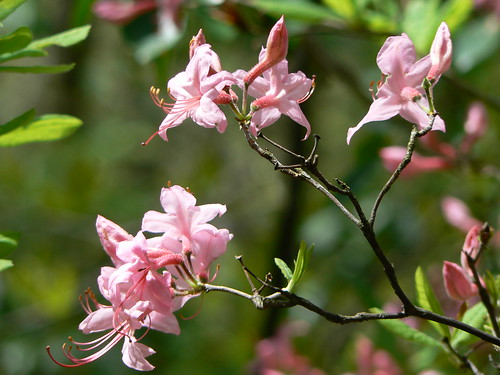
Blooming Azaleas

Log silhouette and Rocky Gap greenery.

Ferns and their shadows

Baby American Chestnut Tree
More pictures of my recent outings to Rocky Gap can be found on my Flickr site. And by request:
| Rocky Gap (Appalachian Trail from VA-601 to VA-632 and back) Mileage: 4 miles round trip Elevation Difference: 1184 feet 4WD Requirements: The last 1.5 miles of VA-601 is a gravel hill, but it is well maintained and I have seen non-4WD vehicles make it up. Trailhead Parking: The VA-601 trailhead has a small parking area to the left. On busy days, cars park on the side of the gravel road. Driving Directions: Along the way, you’ll pass by Sinking Creek Bridge, a covered bridge built in 1916. |
Steve Sillett’s Secrecy and the Virginia Round Leaf Birch
Over the winter, I read The Wild Trees and learned about the botanists and climbers who studied the diverse ecosystems in the canopies of the giant redwoods. I enjoyed the book and you can read my original thoughts in an earlier post.
Now, I do have to admit there was one section where I scoffed at scientist, Steve Sillett. Once his research started to take off and he was being interviewed for The New Yorker, he kept the locations of the trees guarded. He was worried about recreational climbers ascending the trees (you know, the same trees he climbed) and hurting the canopy.
“Oh, give me a break!” I thought.
Steve had started his tree climbing career recklessly in college without any ropes and just a few chapters earlier, he had to be reprimanded by arborists for climbing the redwoods using metal logging spikes. Was he really the one to be lecturing?
But now, I definitely have a new appreciation for Steve Sillett’s secrecy and I humbly recognize that one can change their mind over the years (or…a mere four months). In Steve’s case, I suppose as he became more familiar with the trees and the ample life at top, he developed a greater appreciation of their fragility. As for me, what changed my mind about Steve?
The Virginia Round Leaf Birch Tree.

Photo by Peter M. Mazzeo @ USDA-NRCS PLANTS Database
The Virginia Round Leaf Birch Tree only grows naturally in Smyth County, Virginia at an elevation of 2750 feet. The tree was discovered in the early 1900s and then it VANISHED for 60 years. It was assumed extinct until 1975, when a small patch was found growing near Cressy Creek. And so, the Virginia Round Leaf Birch became the very first tree protected under the Endangered Species Act.
What a delicate treasure these trees must have been! Surely, anyone who ran across such a rare tree would cherish and respect the moment. No one would want to hurt the precious few that remained, right?
WRONG! In 1984, “Vandals dug up and removed, uprooted, or cut off at ground level all but 5 of the 30 healthy, 2-year-old seedlings in Sugar Grove, Virginia”
What the–?!?! Who would do such a thing?
After that, the planting locations of the Virginia Round Leaf Birch were kept secret. Although less than 10 of the natural population remain, thanks to secrecy, there are more than 1000 artificially propogated trees out there and the species has successfully moved from “Endangered” to “Threatened”.
So, Steve Sillett, I believe you were right to be discrete about the redwoods, afterall.
Even the population of people who love trees still has its jerks.
10 Things in my Yard
I was sick all last weekend and didn’t get to venture far from home. But, thanks to six years of limited yardwork, I have plenty of vegetation to see in my backyard.
Inspired by the No Child Left Inside Coalition video that said “young people could identify 1000 corporate logos but fewer than 10 plants or animals native to their backyards”, I went outside and took pictures of things in my yard. So here are 10 Things in my Yard:
 |
Flowering Dogwood
State tree AND flower of Virginia, State tree of Missouri, State flower of North Carolina Dogwood I learned at a pretty early age. One day, my siblings and I decided we would build a tree house. There were very few obtainable trees to our short statures. We selected the only one we could reach and nailed no more than three boards into the branches when we were reprimanded by our mother. Apparently, it is against the law to damage the state tree. And that was that. It was going to be a pretty sucky treehouse anyway. |
 |
Gray Birch
I don’t have a good story about birch trees. But I will say every time the Direct TV goes out in the summer, this tree is one of my first scapegoats. It has grown so high, I keep waiting for it to block the satellite dish. I’m still waiting. |
 |
Mayapple
I was officially introduced to Mayapples last year by Jere Bidwell on our Cornelius Creek hike. Mayapples sport a single bloom which hides under their umbrella-like canopy, so you can’t see the flower from above, you have to look for it! |
 |
Silver Maple
This tree never stuck out to me as extraordinary until Sean’s Dad came to visit the house. He is a fan of this tree and actually mentions it pretty regularly. |
 |
Sugar Maple
State Tree of New York, Vermont, West Virginia and Wisconsin. This is another tree Sean’s Dad taught me. When I first moved into my house I was told that this particular tree wouldn’t last because it was growing into itself. After all the trees I have seen survive under sketchy conditions, growing on rocks, merging back into themselves, eating fences and blazes and even combining with other trees, I decided this one is a big pansy if it can’t figure the matter out on its own. So far it is still going strong. |
 |
Tulip Poplar
State tree of Tennesse, Indiana and Kentucky. This is the favorite tree of my Great Uncle Chuck and my sister. Great Uncle Chuck likes it for practical reasons, “It grows fast and the wood is strong.” Carolyn likes it for a different purpose, “Because it’s easy to identify.” Since two of my favorite people like this tree, the species will always have a place in my heart. |
 |
Sycamore
Sycamores I learned at a very early age as well. My grandmother used to point them out when we went to visit Mount Vernon. I also remember Sycamores from the Bible story of Zacchaeus. He was the short tax collector, who couldn’t see Jesus through the crowd. So he climbed a Sycamore tree to get a better view. The more I see Sycamore trees, the more I wonder about that story. The branches are so far off the ground. How did short Zacchaeus ever get up there? 🙂 |
 |
Crabapple
This is a new tree to me. I chose to highlight it in this list of ten because I like the pretty blooms. It seemed flashier than “Dandelion” or “Wild Strawberry” |
 |
Poison Ivy
Even though I learned this one at a pretty young age, I managed to have negative encounters with this plant well into adulthood. Most notably, I once got poison ivy on my face trying to rescue a goat from the wood pile. |
 |
Virginia Creeper
Virginia Creeper is commonly mistaken for poison ivy. But it is waaaay cooler. It is featured in the state seal of Virginia! My relationship with Virginia Creeper began with Tony Airaghi. Since then I have become very fond of the plant, especially in the fall. |
And there you go, 10 Things in my Yard, which is only about 1/3 of an acre. I certainly don’t want to put you on the spot, but I wouldn’t mind seeing 10 things from *your* yards.
Especially since I’m *cough* *cough* still sick and I can’t get to the AT. 🙂


 TGAW
TGAW 
Recent Comments