Posts filed under ‘trees’
Trees and The Kite Runner
In 1992, the city of Sarajevo had 26,111 trees. Three years of war later, only 6,117 remained. Faced with a siege, the residents of Sarajevo had no choice but to cut down the trees to heat their homes, to cook their meals, to survive. Some time ago, I read a compelling quote that has stuck with me. It’s from Kemal Kurspahic, the editor in chief of a Sarajevo newspaper:
“Do whatever you can to stop the killing, to bring about peace, and then bring us trees.”
-Kemal Kurshpahic, Oslobodjenje, Spring 1998 Issue
(Also see Releaf Returns to Sarajevo)
This first thing on his wishlist was peace. Second up— trees.

The best-selling novel The Kite Runner focuses on another war-torn city, Afghanistan’s Kabul. Author Khaled Hosseini is describing a different city and a different war, but he still hits upon the loss of trees.
Part of his effectiveness comes from describing the many ways trees touched the lives of citizens in happier times. Descriptions and cameos of trees litter the entire novel. Although a particular pomegranate was prominent, it wasn’t the only tree accounted for in the book. A wealth of species – willows, pines, cypresses, cherries, apples, mulberries, gums, acacias, poplars, palms, persimmons, hibiscuses, loquats, birches and oaks- made appearances.
Trees were used to describe locales and landmarks. Jalalabad described as “the city of cypress trees and sugarcane fields.” A passage on Islamabad’s panoramic view mentions “rows of clean, tree-lined avenues and nice houses.” One of the main characters lived “[o]n the south end of the garden, in the shadows of a loquat tree.” Meanwhile, another character was buried “in the cemetery on the hill, the one by the pomegranate tree.”
Trees described people. The main character recalled sitting on his father’s lap as a child “like sitting on a pair of tree trunks.” He described his father’s strength by saying he had hands that “looked capable of uprooting a willow tree.”
Trees were used to portray affluence. A rich boy’s house was described as “a posh, high-walled compound with palm trees.” A family friend’s two-story home “had a balcony overlooking a large, walled garden with apple and persimmon trees.” Later in the novel, a character speculates on another’s privileged upbringing. Part of his tirade– the presence of fruit trees.
You probably lived in a big two- or three-story house with a nice backyard that your gardener filled with flowers and fruit trees. All gated, of course. Your father drove an American car. You had servants, probably Hazaras.
Trees were functional. Their fruit was ingested and their shade was enjoyed. The kites that were the namesake of the tale were also aided by trees. After the boys ran the kite strings through a “mixture of glass and glue”, they would hang “the line between the trees” to dry. The author even described how a snapped tree branch served as a credit card for two young boys.
Hassan and I would take the wooden stick to the bread maker. He’d carve notches on our stick with his knife, one notch for each load of naan he’d pull for us from the tandoor’s roaring flames. At the end of the month, my father paid him for the number of notches on the stick.
Trees illustrated the happy childhood of the two main characters. They chased each other “between tangles of trees” and “used to climb the poplar trees” to annoy their neighbors. The boys would respectively tell and listen to stories under a pomegranate tree. The same pomegranate tree documented the boys’ friendship in the form of their carved names and continued to do so for decades. Happiness and trees were so synonymous that at one point, one boy was able to cheer up the other simply by asking, “Do you want to go climb our tree?”.
In the book the main character escapes the turmoil of Kabul and eventually settles in America. After roughly 19 years, he returns to the city of his youth and is struck by the devastation. One change he definitely notices is the trees. When he first arrives in Afghanistan, he notes that “pine trees flanked the road, fewer than I remembered and many of them bare.” When he reaches the center district of Kabul, he discovered, “There weren’t as many palm trees there as I remembered.” At his childhood home “most of the poplar trees had been chopped down.”
As he had a somber reunion with his city and he watched children playing in ruins and mule-drawn carts swerve around debris, he had a question for his driver.
“Where are the trees?” I said.
“People cut them down for firewood in the winter,” Faris said, “The Shorawi cut a lot of them down too.”
“Why?”
“Snipers used to hide in them.”
A sadness came over me. Returning to Kabul was like running into an old, forgotten friend and seeing that life hadn’t been good to him, that he’d become homeless and destitute.
Because Hosseini had been consistently reminding us about the presence of trees throughout the story, this conversation has all the more impact. When I read The Kite Runner, I found myself coveting two things for the Afghan people– peace…and trees.
The former may be tricky, but there are numerous organizations already helping out with the latter.
Future Generations Canada
Afghans4Tomorrow’s Bare Root Trees Project
UNAMA

Anthony Miller Plants an Apple Tree in Afghanistan (Photo by USDAgov)
Fall Colors: UW Arboretum
Here in Elizabeth City, my Red Maple is doing justice to its name… but there is still quite a bit of green in my yard, including the baby American Chestnuts. So let’s live vicariously through Wisconsin again! On October 20th, my boss Larry and I had enough afternoon daylight to explore the FREE! UW Arboretum in Madison.

Blue Sky, Yellow Aspen, Red Tupelo

Changing Maple

Yellow

Dusting of Color

Red Crabapples

Yellow Berries

Slate and Green

Field

Curious Field Bird

Sun Through Leaves and Grasses

Surprise Purple
More pictures of the UW Arboretum are available on my Flickr site.
Fall Preview
In Elizabeth City, North Carolina, I’m still waiting for a lot of the leaves to change. There is no hope for the pines, of course. The Bald Cypresses have started to brown and a few of the other species have decided it is fall just in past week. The baby American Chestnuts are still green, but a few of the baby Pawpaws have started to yellow. Overall, the predominant color is still green. Two weeks ago, I was in Wisconsin for business. Wisconsin trees have solidly acknowledged it is autumn and the result is beautiful! One afternoon after my day’s meetings, I went for a quick walk around my hotel. I got to enjoy the crisp air, the sound of leaves crunching under my feet and get a quick preview of what’s to come back home. : )

Leaves on the Ground!!!

Changing Maple… and a Skeleton!

Nature Taking Over Nature

Lichen and Tree Bark

Green and Yellow

Composting

Witch Way?

Oak Leaves
More pictures of my walk in Marshfield, Wisconsin can be found on my Flickr site.
Heart in Nature – Via Facebook!
Recently Facebook sent me a message that an old co-worker tagged me in a picture.
“Ooooh….that can’t be good,” I thought. I hadn’t seen her in about a decade. Whatever picture she had of me was one I didn’t remember. It had the potential for embarrassment.
As a I clicked on the link, I noticed the picture was in a folder called “Mobile Uploads”.
“Mobile Uploads?!?! Did cell phones even take pictures back then?”
It turns out it was indeed a mobile upload shot. It was a recent one. Not of me, but of something I would appreciate!
Courtesy of ever-lovely Jennifer Maccherone, here’s a great Heart in Nature… via Facebook!

Heart Shaped Knot (Photo Courtesy of Jennifer Maccherone)
Hungry Tree – Human Heads
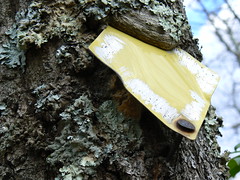
Three years ago on John’s Creek Mountain Trail, I observed a large number of metal blazes being absorbed by their host trees:
 |
 |
 |
 |
Flashback to John’s Creek Mountain Blazes
The phenomenon is MUCH more amusing, however, when there is a little hiker on the metal blaze:

Credit: ????
(Hat Tip, Dave O!)
Tree on Tree Fail – R.I.P. Baby Pine
Trees choosing to grow on other trees don’t always have happy endings! Last year, Ryan and I ran into a baby pine growing on a dead tree hiking on Merchant Millpond’s Lassiter Trail:

Baby Pine Growing – March 2009
We revisited it during my 35th Birthday Hike, roughly a year later. Alas, the baby pine had perished.

Vicky Laments Baby Pine – March 2010
Farewell, Baby Pine. It was a good try! 🙂
Tree on Tree Action
For Earth Day 2009, I did a blog post entitled “Recycling Bald Cypress Trees“. It shared a number of pictures ranging from little barnacles clinging to cypress knees to comfy looking goose nests to even trees growing on top of decaying stumps.
While kayaking two Saturdays ago, Ryan and I paddled upon another example. Here’s a tree we ran across as Newbegun Creek widened up into the Pasquotank River. It was right near the fancy schmancy residences off Orchard Dr.

Me By Bald Cypress Tree (Photo by Ryan Somma)
Take a closer look at the boxed section. That’s not part of the bald cypress tree growing up there! Nope– something else entirely has made a home at the apex of that curved branch:

A Tree Growing on Another Tree (Photo by Ryan Somma)
Once again, I find myself impressed by the resiliency of nature and the remarkable venues it chooses to thrive.
P.S. Don’t by any means think this is a unique example! Richard Preston’s The Wild Trees describes impressive ecosystems found in the canopies of the giant redwoods.
Heart in Nature: Knot in Newbegun Creek
Kayaking in Newbegun Creek a couple of weekends ago, Ryan and I stumbled upon this heart-shaped knot. Its appeal wasn’t limited to our eyes– some plants found it to be a rather nice home.

Heart in Nature – Knot (Photo by Ryan Somma)
Wedding Behind the Scenes: Tree Tablecards
We had beautiful succulent-inspired invitations designed for us by Rachelle Somma. Originally when we were tackling table cards, I took her invitation design and simply numbered the tables… in binary. 0001, 0010, 0011, 0100, etc. I sent them over to Ryan for review. Then I heard something I never thought I would hear Ryan say.
“I’m not really feeling the binary.”
Ryan and Binary not getting along?!? This is a man who has binary on his license plate. Heck, this was a man who kept track of his Relay for Life laps in binary!
Ryan had a brilliant counter suggestion, “Why don’t we do trees instead?”
With that, our tables went from one of his loves to one of mine! Ryan quickly found a website of public domain leaf silhouettes and he embarked on getting all the table cards ready in Photoshop.

Ryan Making Table Cards…with Mollie
NOW…. I don’t think I’m a Bridezilla. At least not yet– I do have 10 more days to completely lose it. BUT I am very particular about trees. And there on the computer screen, this “Treezilla” spied some troubling leaves.
“That tree doesn’t grow in the Virginia.”
“That’s a bush.”
“Click on that– do they have Black Locust instead Honey Locust?”
“I think we need a Tulip Poplar– that’s Uncle Chuck’s and Carolyn‘s favorite.”
“I never even seen THAT tree!”
Patient, patient Ryan gently reminded me, “Sweetie, they don’t all have to mean something.” and he was absolutely right. I sat back down.
But when we decided we wanted to have an American Chestnut tree and we had to hand edit a leaf logo from the American Chestnut Foundation, that opened up the door for leaves that weren’t on the website! Along with American Chestnut, Tulip Poplar and Sassafras snuck in.

Our Leaves… with Qubit
When it was all said and done we had quite an array of table cards. Eleven trees and two bushes. With one exception I have personally seen each and every one of these leaves in the Commonwealth of Virginia. Ryan was right– they all didn’t have to mean something. But it just so happens with our three additions, I have a memory associated with each (which isn’t an especially unique property– there are a number of species I could say the same about).
- Black Locust— probably one of the first trees I ever learned! It was prominent in my childhood home and is my father’s favorite tree because it burned so hot in his fireplace. : )
- American Chestnut – a persistent species which after a century of defeats from the blight fungus continues to sprout again in hopes for better odds. This is a tree that reminds me of our birthdays. On Ryan’s 35th birthday, we stumbled on an American Chestnut bur on a hike. On my 34th birthday, we attended the planting of a blight resistant hybrid.
- Cherry – A cherry tree grew in my maternal grandmother’s yard. Each year we would tie plastic alligators and baby dolls to the branches in a futile effort to scare the birds away from the fruit.
- Tulip Poplar – My Great Uncle’s favorite tree because it grows fast and straight. My sister’s favorite because it is easy to identify.
- Mulberry – Ryan, my mother and I ran across Mulberry bushes together on a walk in Occoquan. The leaves are so oddly and uniquely patterned. I remember thinking at first that they were eaten by insects.
- Silver Maple – A tree that grew in the front yard of my home in Blacksburg.
- Red Maple – A tree I learned after moving to Elizabeth City. By seeing its spring flowers at Fun Junktion and its autumn leaves at Camden Causeway, I truly learned why it earned the distinction “red”.
- Lilac – A bush with such an amazing scent. A townhouse I lived in Blacksburg had a common area full of them. Their purply goodness was phenomenal each spring (and readily covered the usual scent of dog poo).
- Horse Chestnut – My Dad tried to trick me once into thinking a Horse Chestnut was an American Chestnut. It’s a common mistake even though the two trees aren’t even related. The tree Anne Frank peered at from her attic is also a Horse Chestnut. Ryan and I visited it in November 2008 when we were in Amsterdam.
- Northern Red Oak – the gnarled, mutated trees that show us just how rough conditions are at the top of Virginia’s Apple Orchard Mountain
- Sassafras – I found two turned Sassafras leaves on the backside of Dragon’s Tooth October 2005. One was burgundy. One was orange. They looked like little Hokie Bird tracks.
- Black Walnut – My childhood home had two enormous black walnut trees– one was home to our makeshift tire swing!
- Cottonwood (Poplar) – This one I hadn’t seen in Virginia. But I did see its brilliance last August in Wisconsin. My co-workers took me on a boat ride down the Mississippi River. The delicate, white seeds were everywhere. They floated like feathers and made the Mississippi seem magical.
I wish I could say I let Cottonwood make the cut because of my Mississippi River memory. But really it was because I was waaaaaay too lazy to make a Sycamore leaf into a silhouette. Have you seen all the points on those suckers?!?
We printed out all our cards on green card stock. For stands, my immediate family had been diligently drinking wine and saving the corks for months. Using an idea we heard on NPR, Ryan sliced them in half with a box cutter and made a slit in the top.

Cut Corks

Standing Leaves
I’m not especially looking forward to making the table assignment cards, but I do look forward to the end product. We’ll have of own little forest of family and friends. 🙂
P.S. To White Oak, American Beech, Bald Cypress, Virginia Roundleaf Birch, Rhododendron, Pawpaw, Mountain Laurel, Pecan, Dogwood, Sycamore, Wollemi Pine, American Holly, Shagbark Hickory, Long-leaf Pine and all the other missed species– I’m sorry. I still love you all! 🙂
*More* Groundhogs in Trees
Last February, I did a post sharing photos of groundhogs….in trees. At the time, the concept was very surprising to me. However, scattered across Flickr are numerous shots capturing similar pairings. Apparently, it is not as odd as it would first seem. In celebration of Groundhog Day, here are even more groundhogs enjoying the high life!

(Photo Courtesy of weavermg)

(Photo Courtesy of danedude)

(Photo by HyperialGuard)

(Photo by hopefoote)

(Photo by hyperbolation)
If you would like to see more examples of these critters who refuse to be labeled by their common name, check out the Groundhogs in Trees Flickr Group.
Have a Happy Groundhog Day!


 TGAW
TGAW 
Recent Comments