Posts filed under ‘trees’
Silo Tree Updates – May 30, 2009
Three more trees have been added to the Silo Trees of the U.S. listing. Kansas’ count went up by two and solely holds the lead once more!

| Entitled “Reclaimed”, this photograph captures a silo tree in Sioux Falls, South Dakota. Photograph courtesy of Dakota Dave. |  |

 |
This tree is located on Highway 24 between Lawrence, Kansas and Perry State Park. The photograph won a juror’s merit award in the 2008-2009 Hays Five State Competition and is courtesy of A. Scott Mccauley |
| Another find by Ken Wolf! This tree is in Douglas County, Kansas. Photograph courtesy of Ken Wolf. |  |
More photos can be found in the Trees in Silos Flickr group. If you spot a silo tree you’d like to share, let me know!
Google Doodle Trees
In her book, Between Earth and Sky: Our Intimate Connection to Trees, Nalini Nadkarni dedicates an entire chapter to “Symbols and Signs”. A small part of that chapter discusses business logos. A few years ago, one of Nadkarni’s students, Jade Leone Blackwater, collected and analyzed tree-related logos. Within only a few days she found over 200 logos. Trees, it turns out, are common in corporate branding.
Last week, Google unveiled their Doodle 4 Google Winners. School children were asked to sketch a Google Logo representing “What I Wish For the World”. Just like professionally designed logos, trees make frequent appearances. Out of this year’s 400 State Finalists, 90 artists, including this year’s winner Christin Engelberth, incorporated a tree into their design.
Nadkarni and Blackwater spotted trends in the tree-related logos they looked at. Some of those same themes can be seen in the Doodle 4 Google entries. Many of the young artists used trees to support messages of sustainability, taking care of the environment, green living and recycling. Sometimes a tree was used to identify a place, such as a beach in paradise or an African Savannah. But most telling are the remaining entries. They used trees to convey a myriad of messages– Love, Safety, Friendship, Peace, Happiness, Fun, Hope, Completion, Longevity, Harmony.

Let the War Leaf
Elijah Griffin

One Happy World
Jessica Hsueh

Gavins Google Respect & Renewal
Gavin Raitt Hughes

Happy World
Aravind Arunachalam

Untitled
Grace Para

Beautiful Land
Kelly Majid

Keep Our Animals Alive
Claire Yuka Bellas

Love Peace Harmony Joy & Happiness
Eshia Rustagi

Treat The Environment Better
Maredeth Steever

Simple Life
Ally Grimes

Creation
Sarah Cook

A World Full Of Pets
Alaina Beaver

I Wish For Love
Brooklynn Leary

I Wish For Safety
Kennedy Zufelt

Untitled
Natasha Marko

Its Good To Be Green
Dakota Brooke Young

Recycling Doodle
Steven Leal

Keep The Earth Clean
Evelyn Larson

Care For The Flowers
Elyse Larson

Recycle For Beautiful Green World
Harshitha Kosaraju

Go Green With Google
Conor Kiely

Helping The World
Galila Lingo

Go Green Recycle
Angeline Faieq

Recycle For The Future
Alyssa Ruehlow

For World Friendship
Elizabeth Boulet

Peace:GR8-4-EARTH
Taylor Hope Mcgraw

Help The World Be Green
Sabah K Islam

I Want The World
Gabrielle Smith

Feed Our Animals
Nicole M Dowling

The Better World
Carli Marie Lynch

A Green Peaceful World
Annie Tsai

Peace Love Hapiness
Jessica Sandler

Conserving Nature
Ashton Brashier

Go Green
Nick Amann

Peaceful World
Logan Stephens

Conserve The Earth
Carlos Lopez

Purple Pants?
Loey Gregory Wiley

Caring Does Matter
Jocelyn K Lee

Endangered Species Matter
Courtney Bodine

Wishes For Peace
Abbigail Barber

Happiness For All
Marissa Schuldheisz

Cleaning Up The World
Adam Cowell

Going Green
Sherry Lambert

Always Having What You Need
Hayden Furman

A New Beginning
Christin Engelberth

Sun And Fun
Austen Westenskow

Electric Tree
Abigail Pearl

Saving More Endangered Species
Arizza Santos

Cleansing The World
Ryan Gielow

Possibilities
Katherine Seeman

Beauty And Peace
Ines Slomic

Untitled
Haley Pontius

Save The Planet
Tiffany Patmon

Unite The World
Ally Weaver

Hope
Camille Saadia Hancock

Live Life
Anna Kapton

Put Things In Perspective
Bridget Johnston

Going Green
Cally Nielsen

Save The Rainforests
Kathleen Stanford

Untitled
Autumn Ibach

Google Green
Sarah Cozzens

World Happiness
Celeste Herrera

Peace And Happiness
Angelica-Eeva Melissa Digiulio

Ideal World
Sarah Mcnaughton

A Day In Paradise
Callie Roberts

Our Common Home
Kathleen Hazleton

Beauty Of Our Envinronment
Abigail I Ray

An Original World
Janae Mehlhaff

Be Seen Being Green
Jadon Mann

Fading Away
Victoria Wolf

Things That Can Change
Yedi Han

Google For Green
Camille Ohman

How The World Can Connect
Lydia Stevens

United We Stand
Amy Muser

If Everyone Lends A Hand…
Charlotte Markle

Peace For The World
Kelsey Carpenter

What A Wonderful World
Josh Voshell

A Wish For Vitual Reality
Natasha Gemine

Change For The World
Keolamaikalani Ahina

Outside Technology Clear Your Mind
Kelsey Driscoll

The Elements Of Completion
Alexandra Olivier

Facing Humanity
Britteny Hudson

Power Plant
Kyle Butterhof

Untitled
Amanda Kehoe

I Wish
Meaghan Parker

A Peace And Love World
Joseph Park

Google Doodle
Jose Alexander Vazquez

Long Lasting World
Jamayra Ortiz

Google Go Green
Jourdan Stallknecht

Beautiful Harmony
Stephanie Georgeson
P.S. If we counted tree-related products such as fruit and leaves, the tally would be even higher!
Arbor Day: Alaska
 Bald Eagle and Sitka Spruce (Photo by DCSL) |
Happy Arbor Day, Alaska!
Alaska celebrates its Arbor Day the third Monday of May, so Happy Arbor Day Alaska! Alaska’s State Tree is the Sitka Spruce (Picea sitchensis). The needles of the spruce trees are high in Vitamin C. In the 1700’s explorers and sailors found spruce beer to stave off scurvy. In fact, before an 117 day voyage past Antarctica, Captain James Cook ordered spruce beer to be brewed. |
|
The pleasures of spruce beer were not lost to history. You can make your own, or if you prefer– you can purchase Alaskan Brewing Company’s Winter Ale. It’s made with tender Sitka Spruce tips. To find out when your state celebrates Arbor Day, check out Arbor Day Dates Across America at ArborDay.org. |
 Alaskan Winter Ale (Photo by faeryboots) |
Arbor Week: Maine
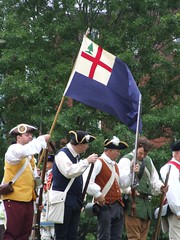 “Pining” for Lower Taxes (Photo by faegirl) |
Happy Arbor Week, Maine!
Last month, on April 15th, protesters convened on various metropolitan areas to conduct “Tea Parties“. They wanted to make a statement about taxes and decided to name their events after a famous 1773 protest – the Boston Tea Party. The tariffs on tea imports weren’t the only controversial good of the times. Maine’s State Tree, the Eastern White Pine, was also a source of great unrest and “a major motivating factor for the American Revolution“. |
The Eastern White Pine grew tall. It’s wood was strong. It was light and rot resistant. This made the tree perfect for the masts of great ships and it just so happened the British had a formidable Navy they wanted to provide for. All Eastern White Pine trees with a diameter greater than 12″ were claimed for Great Britain. It didn’t matter where the tree was or who lived on the land. The tree was marked with a Broad Arrow and just like that, it was property of the king. Valuable material was snatched away. The trees became souvenirs of injustice and “weighed heavy on the minds and hearts of the colonists desire for independence“.
In the winter of 1772, sawmills were caught violating the law and using the marked trees. That spring, a sheriff and his deputy arrived in the town of South Weare, New Hampshire with orders to arrest the leader of a sawmill. As the two men rested in a local inn, they were assaulted by a group of twenty men. The sheriff and his deputy were lashed. Their horses were disfigured. Then both men and their horses were driven away in disgrace, heckled by the townspeople.
This community’s uprising is called “The Pine Tree Riot“. The date was April 13, 1772– more than eighteen months before the Boston Tea Party.
As rebellion grew into revolution, the first Continental Flag was conceived and was reportedly present at the Battle of Bunker Hill. A reminder of what they were fighting for was included in the design. It wasn’t a teabag on the flag, it was a tree.
An Eastern White Pine.
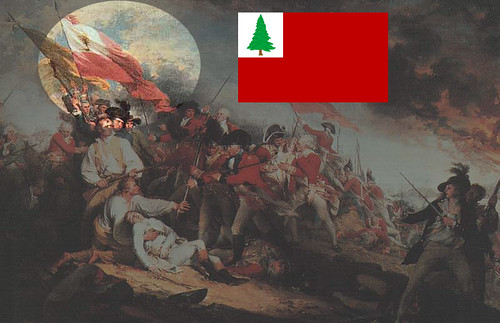
Jonathan Trumbull’s Battle of Bunker Hill
To find out when your state celebrates Arbor Day, check out Arbor Day Dates Across America at ArborDay.org.
May Trainings for American Chestnut Data Collection

|
Two organizations I’m fond of, the Appalachian Trail Conservancy and the American Chestnut Foundation, are working together to gather data on American Chestnut trees growing along the Appalachian Trail. If you are interested in volunteering, two training sessions are coming up this month. |
The Trainings
- May 23, 2009 Mountain Lake, VA -Katie Burke, UVA PhD Candidate studying chestnut ecology, with Kathy Marmet
- May 30, 2009 Nantahala Outdoor Center, NC – Dr. Hill Craddock and Dr. Jennifer Boyd of University of Tennessee Chattanooga Dept of Biological & Environmental Sciences
Formal training from 10 am – approximately 3 pm
Data collection practicum after lunch break
Please reply to kathymarmet[at ]gmail[dot]com if you would like to participate
Space is limited for these trainings. Additional trainings may be scheduled if there is sufficient interest.
The Project
The Chestnut Project is part of the Appalachian Trail Conservancy (ATC)’s AT Mega-Transect Project, which seeks to engage the public in citizen-science efforts to collect data along the AT to raise awareness of threats to the environmental health of the Appalachian Region.
In 2008, scientists and volunteers from The American Chestnut Foundation (TACF) and Potomac Appalachian Trail Club (PATC) worked together to develop a pilot project to recruit and train volunteers to collect data on American chestnut trees identified along the Appalachian Trail (AT). Data from the 2008 effort and a slide show summary are at: http://chestnut.cas.psu.edu/mega-transect.html
The Chestnut Project will be a long-term project. Data collected by project volunteers will contribute to understanding the status of surviving remnants of a species that played a key role in forests throughout Appalachia before being devastated by a blight fungus imported with Asian chestnut trees in the early Twentieth Century, and will inform TACF’s multi-generational effort to restore the American chestnut tree to its former place in the region’s forests. Data on individual trees with the potential to produce flowers will assist TACF in increasing the genetic diversity of its backcross breeding program to produce an otherwise American chestnut with the blight resistant characteristics of Asian chestnut.
2009 data collection efforts will build on the results of the 2008 effort, and will focus on assessing and improving data reliability. Redundant counts by multiple teams will take priority over number of miles covered by counts. ATC plans to seek grant funding with TACF and other partners
Participant Commitment
Training participants will select initial data collection segment assignments at the training. Participants as asked to try to collect and submit data from at least one segment within two weeks of the training, and to plan to complete and return data for all segments selected at training by July 10.
A Data Collector Kit, including report forms to record data in the field will be provided at training.
Helpful Items
GPS locator, binoculars, pedometer, digital camera, trail maps, hand held microscope or magnifier, clipboard.
Lazarus Taxon and Identification By Cage
There are so many intricacies to tree identification– Are the leaves simple or compound? Do they have hair on them? Are they waxy in texture? Are the leaves alternating or opposite of each other? What are the twigs’ terminal or lateral buds like? How is the bark textured? What color are the flowers? When do said flowers bloom? Is there any evidence of nuts on the ground? What about fruit?
When I was in the Norfolk Botanical Gardens a week ago, I was able to recognize a tree using a different method entirely. I identified it based on the cage around it.
Walking in the rain near the observatory tower, I noticed familiar black bars surrounding a small tree.
“Is that a Wollemi Pine?!?!” I exclaimed and scurried closer. A little sign in front of the tree confirmed it was true.
I first encountered the Wollemi Pine at the Hortus Botanicus Amsterdam last November. It was particularly intriguing because I was on a Lazarus Taxon kick. “Lazarus Taxon” is an official term for my “I See Extinct Things” posts. It refers to species that disappeared from the fossil record, were believed to be extinct and were suddenly discovered alive. The term’s etymology is Biblical– Lazarus was the man Jesus brought back from the dead.
The Wollemi Pine is a textbook example of a Lazarus Taxon. Although fossils of the tree date back 90 million years, for the last 2 million years there wasn’t a single trace of the tree. There was every reason to believe it was extinct. And then in 1994, some were found growing in Australia.
I suppose being one of the oldest and rarest tree species in the world does warrant a little extra protection. At least two cities agree. Amsterdam and Norfolk, separated by an ocean, both enclosed their Wollemi Pines in black fencing.
By doing so, they introduced a new characteristic, a new trait, to the tree. Another way to recognize it.
 Wollemi Pine in Amsterdam |
 Wollemi Pine in Norfolk, Virginia |
More photos of the Amsterdam Botanical Gardens and of the Norfolk Botanical Gardens are available on my Flickr site.
Arbor Day: North Dakota
 American Elm Leaves (Photo by gravitywave) |
Happy Arbor Day, North Dakota!
North Dakota celebrates its Arbor Day the first Friday of May, so Happy Arbor Day North Dakota! The American Elm, North Dakota’s State Tree, was a favorite of Central Park designer Frederick Law Olmstead and he wasn’t alone. American Elms were planted along the streets of cities and towns across the nation, including North Dakota! |
Despite the presence of Dutch Elm Disease, the city of Fargo still has 7100 American Elms along its streets. Just like with oaks, the affection for the species is reflected in names. Only this time, it is manifested in items named after the tree. North Dakota is home to an Elm Road (Hazen), at least six Elm Avenues (Barnes, Morton, Richland, Stark, Dickey, LaMoure) and at least seven Elm Streets where nightmares may or may not be had (Fargo, Cass, Ransom, Benson, Traill, Morton, Barnes). The state even has a small town simply named Elm.
To find out when your state celebrates Arbor Day, check out Arbor Day Dates Across America at ArborDay.org.
Hungry Tree Versus Bicycle
Vashon Island, Washington has an interesting landmark. An old bicycle embedded in a tree. It’s near the intersection of Vashon Highway and SW 204 St. If you need exact coordinates, I believe you can find them from the Vashon-???? geocache. : )
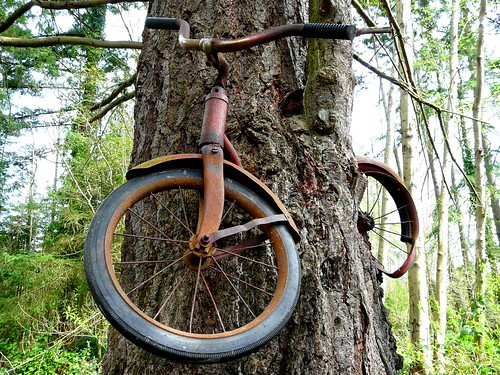
Vashon Island Bike Tree (Photo by sea turtle)

Closeup of Vashon Island Bike Tree (Photo by sea turtle)
To read more about the bike (and see additional pictures), check out this entry from Kent’s Bike Blog describing a 2007 visit.
Arbor Day: Vermont
 Vermont State Quarter |
Happy Arbor Day, Vermont!
Vermont celebrates its Arbor Day the first Friday of May, so Happy Arbor Day Vermont! In 1949, Vermont selected the Sugar Maple as its state tree due to the large popularity of “sug’rin’“, the act of making maple syrup. Until cane sugar was introduced in the 1800’s, the U.S. got much of its sugar from Vermont and Sugar Maple Trees. In contemporary times, the state still produces its most famous crop. In 2006, Vermont led the nation in maple syrup production. |
The fisherman in the show Deadliest Catch have to produce their yields under strict time constraints. Depending on the species of crab, the fishing seasons can be quite short– days even. The maple syrup industry also has to work within a small window of time, one determined by climate.
Sap production is a complex, temperature-sensitive process (Nalini Nadkarni explains it in detail in her book Between Earth and Sky: Our Intimate Connections to Trees). In order for sap to flow, the maple trees need the temperature to drop to below freezing at night, but get above 40 degrees Fahrenheit during the day. In 2006, when Vermont collected roughly 19,780,000 gallons of sap to make 460,000 gallons of maple syrup that window, the sap season, averaged 28 days long.
Because sap production is such a sensitive process, there is valid concern about the industry should temperatures continue to rise.
To find out when your state celebrates Arbor Day, check out Arbor Day Dates Across America at ArborDay.org.
The American Chestnut Foundation on Facebook

|
The American Chestnut Foundation is now on Facebook! Want to read about chestnut news and events while you are already perusing Facebook? Or better yet, want to donate to their cause online? Become a fan of their page! |


 TGAW
TGAW 
Recent Comments