Posts filed under ‘trees’
Kelly’s Knob in the Snow
Greetings everyone! I hope you had a happy and healthy holiday season. The weekend before Christmas, Ryan Somma and I headed to my old stomping grounds in Blacksburg, Virginia for a five day visit. There I got one of the best early Christmas presents a girl could hope for– a reunion with the mountains! : )
On Sunday, December 19th, we got to hit the Appalachian Trail with the dogs and our friends Tony and Meredith. We went from the Rocky Gap/VA-601 trailhead up to Kelly’s Knob. It’s about a 3.8 mile round trip. It starts off steep with a roughly 500-600 foot ascent in the first half mile (Source: Elevation Map from weaselworks). Don’t let the beginning fool you though, once you make it up to the intersection of the John’s Creek Mountain Trail, it is all ridgeline and smooth sailing.
I’ve done Kelly’s Knob a number of times (see my other Kelly’s Knob posts), but this time was by far the snowiest. When we started our hike, there was a lone set of footprints already in the snow. Apparently that hiker was fooled by the steep beginning because surprisingly soon the footprints disappeared. That left us with fresh snow to hike in.

Appalachian Trail En Route to Kelly’s Knob
The top was as gorgeous as usual. As I have written before, you can see the Virginia Tech campus from Kelly’s Knob. That particular day, we didn’t take advantage of it. None of us were courageous/foolish enough to climb out onto the snow-covered rocks. Luckily, what we could see from the security of the trail was quite striking.

Frosted Tree Tops

Snow Covered Rocks at Kelly’s Knob

Rocks and Ridges at Kelly’s Knob

The Knotty Kelly’s Knob Tree and Ridges
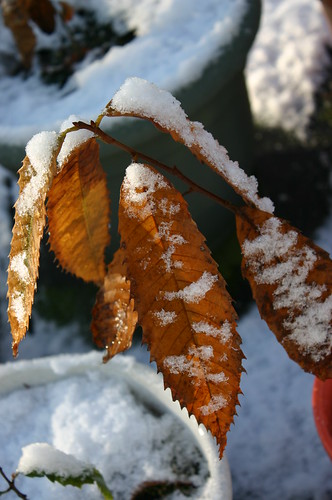
I didn’t see any American chestnut trees as we hiked (there are a whole bunch of them south of Rocky Gap) but I did spy an American Chestnut leaf in the snow!

American Chestnut Leaf in the Snow
The most trecherous part of our journey (for the humans) was actually driving home. With intentions I’m certain were good, someone had attempted to plow the gravel VA-601. Unfortunately the efforts had produced a formidable sheet of ice. We had 1.5 miles back down to paved and cleared road. 1.5 miles of a steep icy road with particularly unnerving dropoffs in lieu of shoulders. Ryan, Meredith and I all agreed Tony would be the most qualified to get us off the mountain. He did not let us down! In 4WD low and in first gear, with occassional brake pumping and steering the vehicle onto exposed gravel or loose snow, he slowly but surely got us down.
My heater in my car was broken which proved to be advantageous to our trusted driver.
“It’s a good thing [the heat’s broken]” Tony pointed out. “Otherwise, I’d be sweating balls right now.” : )
Thanks to Tony’s patient driving, we all got to go home with untainted memories of another great adventure.

Jimmie, Tony (The Hero!), Henry, Meredith and Vicky

Ryan Descends with Henry and Jimmie
More pictures of our hike to Kelly’s Knob can be found on my Flickr site.
| Rocky Gap to Kelly’s Knob (Appalachian Trail from VA-601 to Kelly’s Knob and back) Mileage: 3.8 miles round trip Elevation Difference: Est. 800 feet 4WD Requirements: The last 1.5 miles of VA-601 is a gravel hill, but it is well maintained and I have seen non-4WD vehicles make it up in non-icy conditions. Trailhead Parking: The VA-601 trailhead has a small parking area to the left. On busy days, cars park on the side of the gravel road. Driving Directions: Along the way, you’ll pass by Sinking Creek Bridge, a covered bridge built in 1916. |
Hungry Trees – Benches
They may fancy metal signs, but trees also have a taste for nearby benches.

Hungry Tree in Lazio, Italy (Photo by karstensfotos)

Hungry Tree in North Dublin (Credit: Shellonious)
Hungry Trees – Metal Signs
Apparently, trees tend crave metal signs the way I crave popcorn. Some more examples thanks to Flickr and Creative Commons. Enjoy!

Yosemite National Park (Photo by justinsomnia)

Indiana (Photo by cindy47452

Philadelphia (Photo by misskoco)

Austria (Photo by Rafael Peñaloza)
A Lesson from the American Chestnut
There’s a common misconception that the American chestnut is extinct. That’s not the case. The large trees may have been decimated by the blight, but you can see plenty of little trees in the Appalachians. Alas, those small trees will eventually succumb to the blight as well before they can reach the large sizes of yesteryear.
But here’s the thing about the American chestnut. It’s incredibly optimistic. The American chestnut is not afraid to try again. The blight will take its the branches. The blight will take its trunk, but when the tree “dies”, the roots send up another shoot to give life another whirl. It’s almost as if the tree shrugs and thinks, “Well, that sucked.” and then moves on.

Chestnuts Aren’t Afraid to Try Again – With the larger trunk blighted, new shoots give it another go.
The weeks following our wedding was an exciting time in the chestnut arena. We got to watch as our seeds germinated. I was amazed at how from the get-go the tiniest baby leaf already looked like an American chestnut. It had itty bitty curved teeth!

Baby D4-28-30, 16 days After Planting – Aww… It’s Baby Leaves Already Have Teeth!!!
We slowly exposed our baby trees to full sun and full wind. We watched them peek out of the top of their pots and continue to grow. I remember how giddy I was when I realized I could clearly make out the chestnuts when we drove down Dawson Street before we reached our road! In June, we celebrated one of the chestnuts reaching 12″ tall.
Then disaster.
Leaving for a trip, I gave the trees extra water. It turned out to be an unnecessary gesture. It rained the whole time we were gone. Worse– the holes in the bottom of our pots were obstructed so all that water queued up. This was not good– American chestnuts are sensitive to overwatering. When we returned home, our formerly happy chestnuts were far from happy. And just like that, they died.
I felt… horrible! The American Chestnut Foundation had put so much work and research into those nuts and I turned around and killed them. I literally lost sleep over it, a fact I couldn’t hide from my mother thanks to Mark Zuckerberg (“Why were you on Facebook at 4 AM?!?”).
After a few days, I realized there was only one thing I could do to feel better. I needed to confess! I called up The American Chestnut Foundation and apologized to the poor employee who happened to answer the phone. She had a scientist call me back to gather up some data about my potting mix, my fertilizer and pot sizes. All I wanted from the conversation was a means to appease my guilt. I ended up with a lot more. At the end of our phone call, the scientist surprised me, an established tree killer, by offering me more seed.
And here’s another confession. I’m not as brave as the American chestnuts in the Appalachians. I didn’t want to try again. I was timid and scared and had to be talked into it! Luckily, I gave in and in mid-June Ryan and I received another package marked “Refrigerate Upon Opening”
Take II
Our second wave of chestnuts aren’t from the “Restoration generation” (B3F3). They are still 15/16 American, but are members of the earlier B2F3 generation.
Pots
Ryan and I didn’t have enough pots to accomodate all of our newcomers, so we bought cheapy biodegradable peat moss pots to get some of the seedlings started. They were shorter than the recommended size, but they did have a surprise side benefit. Those pots dried out super fast, helping me avoid the overwatering mistake from my past. Later in the summer we invested in real pots for all the seedlings! This time, we verified each and every hole in the bottom and in a couple of cases, poked extra holes. : )
On the surface, it looked like the small peat moss pots did the trick, but I will note that all of our tallest seedlings were ones that were planted in the bigger pots from Day One.

The Temporary Homes
Germination Stats
With the help of Jacal, we planted 48 nuts. Some of them had crazy long radicals. We cut the radical down to 1/2″ for 11 of the nuts. The remaining seed we left the radicals completely in tact. Two nuts were moldy and didn’t have radicals. One nut’s radical broke. Out of those 48 nuts, we had 45 germinate. Yup– the moldy nuts and the one with the broken radical were the ones that did not make an appearence.

Jacal Planting Seed
Potting Mixture
Our soil mixture was the recommended 1/3 peat moss, 1/3 perlite and 1/3 vermiculite. Jacal helped me mix it up.

Jacal Prepares our Soiless Potting Mix
Germination Time
Germination was substantially faster this time. In March, it took our seeds roughly 13 days to poke up out of the soil. The June wave, took just 4 days before baby chestnuts made their above soil debut.
Fertilizer
Chestnuts like slightly acidic soil with a pH between 4.5 to 6.5. For fertilization, I used MiracleGro for Azaleas, Camellia, Rhododendron (it’s geared for “All Acid-Loving Plants”). It was recommended that I fertilize them every other week. Once the hurricanes and tropical storms started coming our way and the plants were getting watered frequently from nature, they were only fertilized once a month (the fertilizer was mixed in water and I was fearful of overwatering).
Pest Control (Or lack thereof)
I did not use any kind of pesticide this summer, but it probably would have been welcomed by the chestnuts. A couple of them were deemed tasty by insects and I did find two cankerworm squatters.

A Baby Chestnut with a Partially Devoured Leaf
Size
Of the twenty-two chestnuts I kept here in Elizabeth City, I did have three casualties. Of the survivors, some have done better than others. My tallest right now was planted on June 17, 2010 and on November 29th, it was 29″ tall.

Jimmie with Chestnuts – September 9th
| Planting Date | Size on 11/29/2010 |
|---|---|
| June 17, 2010* | 24″ |
| June 17, 2010* | 29″ |
| June 17, 2010* | 15″ |
| June 17, 2010* | 11″ |
| June 17, 2010* | 24″ |
| June 17, 2010* | 16″ |
| June 18, 2010 | 9″ |
| June 18, 2010 | 10″ |
| June 18, 2010 | 6″ |
| June 18, 2010 | 12″ |
| June 18, 2010 | 7″ |
| June 18, 2010 | 12″ |
| June 18, 2010 | 6 1/2″ |
| June 18, 2010 | 12″ |
| June 18, 2010 | 18″ |
| June 18, 2010 | 11″ |
| June 18, 2010 | 9″ |
| June 18, 2010 | 10″ |
| June 18, 2010 | 7 1/2″ |
*Originally Planted in Larger Pots
Fall Colors
I may have planted these guys late, but apparently they got to grow a little longer here in warm North Carolina. On Facebook, I saw someone’s Restoration chestnuts in Traverse City, Michigan yellowing in early October. Our chestnuts didn’t start to yellow until nearly a month later. I first spotted changing leaves on November 17th.

Yellowing Chestnuts – November 18th
The chestnuts got their first glimpse of snow of December 5, 2010. As you can see, some of them are STILL sporting green leaves!
Chestnuts’ First Snow – 12/5/2010

Chestnuts’ First Snow – 12/5/2010
The Neighborhood Kids
As with many of our endeavors, the neighborhood kids were involved. Above you saw that Jacal helped with the soil mixing and the planting. When Ryan and I traveled to Cape Cod this summer, the chestnuts stayed healthy under the watchful eye of Dada, Vick and Risha. But here is my favorite American Chestnut/Neighborhood Kid story (so far):
Over the summer, 4th grader Tyrek came over for a visit. We talked on the back deck surrounded by all the little baby chestnuts and all the little baby pawpaws. Tyrek was telling me a story when he suddenly stopped in mid-sentence. He looked at his surroundings and said, “Vicky, these trees make me happy!”
My reply— “They make me happy too.” : )
And there you go! Sometimes trying again can be terrifying. Sometimes trying again seems hopeless. But sometimes… sometimes trying again will bring you something to smile about.
Additional Resources
Please note– this post is just a discussion of my experience and I am far, far, far from an expert and am still learning myself. If you are interested in growing American chestnuts, I recommend the following references:
TACF Fact Sheet – How To Grow Your Chestnuts
Growing Chestnuts From Seed – Long Instructions from Meadowview Research Farm
Growing Chestnuts From Seed – Quick Instructions from Meadowview Research Farm
The Chestnut Growers Mailing List (Great resource for questions and answers)
|
For more information of donating to or becoming a member of The American Chestnut Foundation, visit: http://www.acf.org |
Behind Michael Nichols’ Redwood Pictures
The October 2009 Issue of National Geographic featured “The Tallest Trees” with wonderful Redwood photographs by Michael “Nick” Nichols. Yan view a slide show of the photographs (and order prints just in time for the holidays!) here.
One of the most dramatic images is actually a mosaic of 84 photographs meticulously stitched together to capture a 1500 year old, 300 foot tree in Prairie Creek Redwoods State Park. It wasn’t a simple venture. In a thick forest, you can’t just back up until everything is in frame. Nichols worked with a team of photographers and scientists and ultimately they rigged up a dollies to get the photographs. You can view the final image online here or in person at Annenberg Space for Photography in the Extreme Exposure exhibit.
I write about this now because earlier this week, the photographer posted a behind the scenes account of the process on The Huffington Post. A couple of names familiar to me from The Wild Trees make appearances. You can also see snippets of their process in the following video from National Geographic. Enjoy!
Hungry Trees – Fences
I’ve shared my fair share of trees eating fences in the past. Here are a few more courtesy of Creative Commons and Flickr users!

Tree Eating Fence (Photo by plays4mee)
And another one from overseas:

Hungry tree in Herfordshire, UK (Photo by anemoneprojectors)
Wedding – American Chestnut
In 2008, I visited one of the research farms of The American Chestnut Foundation and learned about their backcross breeding effort to restore the American chestnut. It’s hard work! Innoculating trees, evaluating blight resistance, pollen collection, flower bagging, meticulous hand pollinations and fall harvests of the spikey burs. After 25 years, all that effort produced the B3F3 generation. Dubbed the “Restoration chestnut”, the trees are 15/16th American and potentially blight resistant. But keep in mind– blight resistance isn’t enough for the trees to rebound in the wild. There’s a very good reason why we couldn’t just throw some Chinese chestnuts in the Appalachians and wish them well. Chinese chestnuts don’t grow fast or tall enough to compete with the likes of tulip poplars and other forest trees. To be successful, the trees would need American growth characterstics with the Chinese blight resistance.
Does the B3F3 generation have what it takes? Does it have the winning combination of Chinese and American traits? To help answer that question, The American Chestnut Foundation invited its Sponsor Members to become a part of their science team. Last March, Sponsor Members were able to receive two Restoration chestnut seeds to grow, measure and report on.
Ryan Somma and I received our seeds on March 17th. We were getting married three days later on March 20th. The timing allowed us to have a very special guest at our wedding. Good people have been trying to save the American chestnut since the blight was first spotted in New York City in 1904. It’s an effort that has spans generations. After 106 years of heartache and hope, Ryan Somma and I had the great honor to plant a Restoration chestnut during our ceremony.

Ryan Plants Our Unity American Chestnut

Ryan and Vicky Water American Chesntut
I can’t say for certain we were the only couple who have had an “American Chestnut Unity Ceremony”, but my hunch is it’s pretty rare. : )
In lieu of gifts, Ryan and I suggested two charities for our guests to donate to. For science, we suggested Elizabeth City’s Port Discover. For nature, we suggested The American Chestnut Foundation. The response was resounding! Out of just the donations that we know about, our guests gave $1392.50 to The American Chestnut Foundation. One of our guests, Ryn R, handmade a card to document her charitable donations. She did her homework. She gave the American chestnut leaves teeth!

Card – The American chestnut leaves have teeth!
It’s been eight months and a handful of days since our wedding and Ryan and I are still fielding questions and witnessing continued chestnut enthusiasm from our family and friends.
To have your loved ones so wholeheartedly embrace and support a cause that is near and dear to your heart…. could there be a wedding gift better than that?
|
For more information of donating to or becoming a member of The American Chestnut Foundation, visit: http://www.acf.org |
Identification of “Identification by Blight”
In December 2008, I stopped on Salt Pond Mountain to snag a season compare shot when some unusual bark caught my eye. Without the leaves I usually relied on, I was able to recognize a little orchard of American chestnut trees…by their blight.

One of the Trees I Spotted On Salt Pond Mountain
This past Sunday, the Roanoke Times ran an article, Researchers work to save American chestnut trees from blight. The article talks about the 40 year effort of Lucille and Gary Griffin to restore the American chestnut. “The project started in earnest,” the article writes, “on Salt Pond Mountain in Giles County.”
So nearly two years after my chance encounter of the trees, I now have a good idea of whose behind them. : )
(Hat Tip, Paul E!)
Hungry Tree – Gravestone
Back in 2007, when I did my original collection of Hungry Trees, I featured a tree in Boston eating a tombstone. Here is a tree “across the pond” with a similiar appetite. Enjoy!

A tree in Nottinham’s General Cemetary (Photo by El Struthio)
ISO: Tree Books
Speaking of trees and books….
The local ecologist blog is looking for books where North American trees and forests serve as main characters. As this list will give me ideas of additional ways to feed my tree fancy, it is in *my* best interest for that list to be as comprehensive as possible. If you have a tree book you would recommend, fiction or non-fiction, definitely swoop over to local ecologist and leave a comment:
Call for books: Ethnobotany of trees & forests

Tree of Books (Photo by timtom.ch)


 TGAW
TGAW 
Recent Comments