Posts filed under ‘trees’
Arbor Week: Oregon
 Douglas-firs (Photo by sillydog) |
Happy Arbor Week, Oregon!
Oregon celebrates its Arbor Week the first full week of April, so Happy Arbor Week Oregon! Oregon selected their State Tree in 1939. They picked the Douglas-fir (Pseudotsuga menziesii). It was a valuable timber tree in the Oregon Territory, in part for its great strength. The wood is said to be stronger than concrete. |
Naturalist John Muir was also aware of the strength of this particular tree. In 1874, he went hiking to witness the effects of a wind storm. Even though he could hear trees fall “at the rate of one every two or three minutes”, he decided to climb a tree to get a better view. He chose a Douglas-fir tree (or Douglas Spruce as he called it). He climbed to the top and hung on as the tree swayed in the strong winds. At times the tree’s top oscillated in a thirty degree arc, but Muir did not worry.
“I felt sure of its elastic temper, having seen others of the same species still more severely tried–bent almost to the ground indeed, in heavy snows–without breaking a fiber. I was therefore safe, and free to take the wind into my pulses and enjoy the excited forest from my superb outlook. “
He stayed in his “lofty perch for hours.”
You can read more about Muir’s adventures that day in Chapter 10 of The Mountains of California.
To find out when your state celebrates Arbor Day, check out Arbor Day Dates Across America at ArborDay.org.
Silo Tree Additions – April 6, 2009
Another silo tree has been added to the Silo Trees of the U.S. listing and we have another state! South Dakota is now represented thanks to a lovely find by Jenah Smith.

 |
Located on a small hobby farm in Watertown, South Dakota, this tree was photographed from inside the silo. Photograph courtesy of Jenah_Smith. |
More photos can be found in the Trees in Silos Flickr group. If you spot a silo tree you’d like to share, let me know!
Arbor Day: Missouri
 Dogwood Bloom (Photo by bored-now) |
Happy Arbor Day, Missouri!
Missouri celebrates its Arbor Day the first Friday of April, so Happy Arbor Day Missouri! Missouri, which is home to four silo trees, has had a lot more consistency with its Arboreal Emblem than Kentucky. In 1955, Missouri selected the Flowering Dogwood (Cornus florida) and has stuck with it ever since. |
That is a commitment to a tree despite its sketchy past and notorious cohorts. Legend has the dogwood implicated in a murder. : )
To find out when your state celebrates Arbor Day, check out Arbor Day Dates Across America at ArborDay.org.
Arbor Day: Kentucky
 Happy Arbor Day, Kentucky!
In this corner, with a height of 60-70 feet with a spread of 40-50 feet, we have the sturdy and strong Kentucky Coffee Tree. And in this corner at a height of a whooping 165 feet, we have the lightening fast Tulip Poplar!
In Kentucky’s history, they had quite a State Tree Controversy. In 1956, the Tulip Poplar was elected as the state tree, but a clerical error forgot to document it as legislation. In 1976, after a two year debate, Kentucky rectified with missing State Tree by selecting the Kentucky Coffee Tree. The debate was certainly heated– “Senators, once friends before the bill proposal, became antagonists. In newspapers and in front of television media, senators made derogatory quips at those even within their own political party.” (Source: Kentucky Library for Libraries and Archives). In 1994, after nearly twenty years of retirement the tulip poplar, apparently the George Foreman of state trees, came back into the ring and was once again took the title of Kentucky’s State Tree.
To find out when your state celebrates Arbor Day, check out Arbor Day Dates Across America at ArborDay.org.
Season Compare: Wye Oak
When a tree is designated as a champion, is the honorary symbol of an entire state and lives for over 450 years, it is bound to show up in a few pictures here and there. The Library of Congress’s Digital Collection includes a Historic American Buildings Survey/Historic American Engineering Record. In it, a 1936 picture of the Wye Oak by E. H. Pinkering . It matches up nicely to a picture by Flickr user Leon Reed.
If you look closely at the latter shot, you’ll notice the missing limb on the bottom right of the tree. There are a number of support wires attached to the tree as well.

Photograph by E. H. Pinkering, 1936

Photograph Courtesy of Leon Reed
For more pictures of the Wye Oak, I recommend Leon Reed’s PhotoStream. He has numerous images of the Wye Oak over the years, including what’s left today.
Arbor Day: Maryland
 Wye Oak (Photo Courtesy of Leon Reed) |
Happy Arbor Day, Maryland!
Maryland celebrates its Arbor Day the first Wednesday in April, so Happy Arbor Day to Maryland! In 1941, when Maryland picked its State Tree, they didn’t just designate a species, they picked an actual tree as well. The species they selected was White Oak and the tree– the Wye Oak from Easton. |
Why the Wye Oak? Until it fell in 2002, the Wye Oak reigned for 62 years as the largest White Oak in the U.S. When it died, it was believed to be more than 460 years old. It started its life decades before European settlers arrived in the area. The entire history of Maryland’s statehood could be encompassed in the lifetime of this one tree.
The Wye Oak was so beloved that through the years, the state made sure its products were put to use. In 1953, the tree lost a branch during a storm. The wood was used to make gavels for the state judges. When the whole tree fell near fifty years later, a $25,000 desk was made for the governor’s mansion. Leaves from the fallen giant were captured in copper to make keepsakes and are still available for purchase. Wye Oak seedlings were sold and are planted across the state of Maryland. Two Wye Oak clones reside at George Washington’s Mount Vernon.
It may have perished, but Maryland’s honorary State Tree manages to live on.
To find out when your state celebrates Arbor Day, check out Arbor Day Dates Across America at ArborDay.org.
Legacy and Inheritance on National Land
The March-April 2009 issue of AT Journeys includes a great article by Wendy K. Probst entitled “A Remarkable Inheritance“. It’s about Dayton Duncan and his work with Ken Burns on the upcoming PBS documentary The National Parks: America’s Best Idea.
In 1959, nine year old Dayton Duncan visited his first national park with his parents. When he was grown with a family of his own, he revisited the parks. His children were able to take in identical views and share the same experiences their father had as a boy. Meanwhile, Dayton Duncan found himself awed by the consistency of the parks.
But sometimes, we don’t want national lands to stay the same. Take the case of the U.S. Army Corps of Engineers’ Philpott Lake in Bassett,Virginia. By the time Congress approved the construction of Philpott Dam in 1944, Virginia’s American Chestnuts had already been ravished by the blight. Patrick County had lost its main cash crop. Gone were the days when wagons were loaded full of nuts and shipped from Bassett. Philpott Dam was completed in 1952 and a new recreation area was born. But it was a recreation area that couldn’t reflect what the forest once was.
On March 18th, Ryan Somma and I joined forest rangers, biologists, Friends of Philpott members, teachers, high school students, and two professional RVers at the Philpott Lake Overlook. We were there to witness the planting of one of the American Chestnut Foundation‘s backcrossed trees, a sapling bred to be blight resistant.

Restoration Biologist Robert Strasser tends to the tree

U.S. Army Corps of Engineers Park Ranger Susan Martin digs
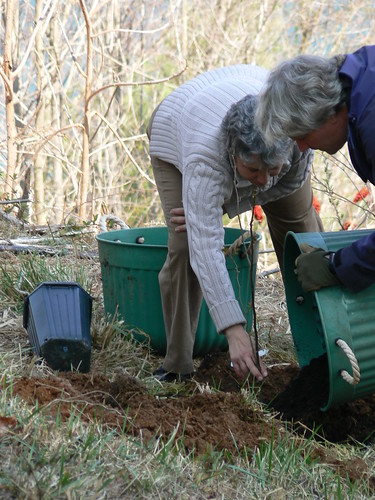
VA TACF President Cathy Mayes and Robert Strasser plant the tree

VA TACF Board Member Dr. John Scrivani fills in the hole
In the AT Journeys article, Dayton Duncan spoke about the value of national parks:
I was able to show my children the exact same scenes — unchanged — 50 years later because we, as a people, had decided to preserved them unimpaired for future generations. That’s a remarkable inheritance[.]
American Chestnut Foundation President Bryan Burhans also thinks about future park visitors, but a little differently.
Your grandchildren someday may sit here at this spot, and the forest may look much different. That is a huge legacy to leave.
The American Chestnut Foundation strives to return the species to the forests in its native range, including Philpott Lake. This little sapling was the first of its kind to be planted in Bassett, Virginia, but it is the hope of all involved that one day it will be far from alone. When we gathered at Philpott Lake that Wednesday morning, we weren’t there just to watch the planting of a tree. We were there to celebrate a coming change to the landscape.
Dayton Duncan described national parks as “one of the last refuges where precious memories can be safely stored from one generation to the next.” Indeed, the American Chestnut Foundation and the staff of Philpott Lake aspire to safeguard memories. It’s just not the memories of adjacent generations.
They don’t want to show my children the small, stunted, black-barked chestnut trees I can find in the forest today. Nor what my father could see when he was he was boy. Not even my grandfather was born into a blight-free world.
It’s my great grandfather. Those are the memories they want to share.
More pictures of the Philpott Lake American Chestnut Planting can be found on my Flickr site.
More information about the American Chestnut and its restoration efforts can be found at the American Chestnut Foundation site.
Silo Tree Additions – March 29, 2009
Two more Silo Trees has been added to the Silo Trees of the U.S. listing. Illinois is now up to two different trees and North Carolina just snagged its fourth.

| This Greenville silo tree is located in Bond County, Illinois. Photograph courtesy of mkloefflerphoto. |  |

| This tree is off of NC-150 on McAlister Road near Lincolnton, NC . Photograph courtesy of kackiejane. |  |
More photos can be found in the Trees in Silos Flickr group. If you spot a silo tree you’d like to share, let me know!
Weekly Winners – March 15th – March 21, 2009

This week’s Weekly Winners come from a variety of locales. I started the week at home in Elizabeth City, North Carolina. Wednesday was an eventful day. We woke up at dawn, did some hiking in Fairy Stone State Park, Virginia. Next we attended the planting of a blight-resistant American Chestnut. The afternoon brought more hiking and then a quiet night in a lake front cabin. The weekend was spent in Occoquan, Virginia where I attended my brother’s 30th Birthday Party.

Henry Relaxing – Elizabeth City, NC

Fairy Stone Lake at Dawn – Fairy Stone State Park

Holly at Dawn – Fairy Stone State Park

Little Mountain Falls – Fairy Stone State Park

Shadowy Trail – Fairy Stone State Park

Learning a New Leaf – Fairy Stone State Park

Park Ranger Susan Martin and American Chestnut Foundation Virginia Chapter President Cathy Mayes Head to Planting Site – Philpott Lake, Virginia
Future of the Appalachian Forests? – Philpott Lake, Virginia

Fairy Stone Lake from Stuart’s Knob – Fairy Stone State Park

Jimmie and Ryan Rest in Cabin – Fairy Stone State Park

Birthday Boy Hugs Girlfriend – Occoquan, Virginia
More pictures of Fairy Stone State Park, the American Chestnut Planting and my brother’s birthday party are available on my Flickr site.
Also, be sure to check out more of this week’s Weekly Winners out at Sarcastic Mom!
Arbor Week: Oklahoma
 Redbud Flowers on a Salad (Photo Courtesy of Corwyn Celesil) |
Happy Arbor Week, Oklahoma!
Oklahoma, which is home to six silo trees, celebrates trees the last full week of March, so Happy Arbor Week, Oklahoma! Oklahoma’s State Tree is the Eastern Redbud (Cercis canadensis). Redbuds are extremely easy to spot in the spring as they are absolutely covered in pink flowers. Those flowers are not only lovely, but they are EDIBLE and make a colorful and tasty addition to salads. |
To find out when your state celebrates Arbor Day, check out Arbor Day Dates Across America at ArborDay.org.


 TGAW
TGAW 
Recent Comments